
Student Handbook · 2026–2027
A-Level
Years 12 & 13
Your guide to sixth form study at Esara — the subjects, the challenge, and where it all leads.
Welcome to Sixth Form
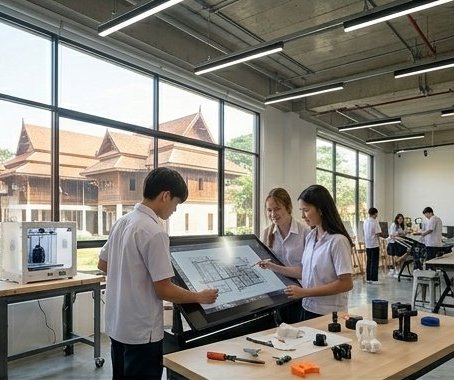


Sixth form is a genuine step up — and that’s exactly what makes it so exciting. A-Levels give you the chance to go deep into the subjects you love, to think independently, and to build the expertise that universities and employers value most.
At Esara, our sixth form is deliberately small and close-knit. Teachers know you by name. Classes are intimate. And the expectations are high — because we believe every student here is capable of remarkable things.
This handbook is your complete guide to our A-Level programme. Read it carefully, talk to us about your subject choices, and come to sixth form ready to do your best work.
At Esara, our sixth form is deliberately small and close-knit. Teachers know you by name. Classes are intimate. And the expectations are high — because we believe every student here is capable of remarkable things.
This handbook is your complete guide to our A-Level programme. Read it carefully, talk to us about your subject choices, and come to sixth form ready to do your best work.
What is A-Level? A-Level (Advanced Level) is the gold standard UK academic qualification for 16–18 year olds. A-Level results are the primary entry requirement for UK universities and are widely recognised by universities around the world. Students typically study three subjects over two years, reaching a deep level of expertise in each.
• Deep subject expertise
• University entry qualification
• Globally recognised
• Independent thinking
• Two intensive years
How A-Level Works
A-Level study at Esara spans two years — Years 12 and 13 (Lower and Upper Sixth). Here’s what you need to know.
📅 Duration
Two full academic years. Year 12 builds foundations; Year 13 develops mastery. All final examinations are sat in May/June of Year 13.
📘 How Many Subjects?
Most students study three A-Level subjects. Three is the standard requirement for UK university entry. Quality over quantity.
📝 Assessment
Primarily written examinations sat at the end of Year 13. Most subjects are 80% exam and 20% coursework or practical.
🏆 Grading
Grades run A*–E. Universities typically require ABB or higher for competitive courses. Predicted grades matter for applications too.

AS-Level (Year 12): In some subjects, students may sit AS-Level examinations at the end of Year 12. These contribute to your academic profile and can support university applications, but do not count towards your final A-Level grade. Your teacher will advise.
Choosing Your Three Subjects
This is one of the most important decisions you’ll make. Here’s how to approach it well.
Start with your university or career goals
Many university courses have specific A-Level requirements. Medicine requires Biology and Chemistry. Engineering needs Maths and Physics. Check requirements early — before you choose.
Choose subjects you genuinely enjoy
You’ll spend two intense years studying in depth. Genuine interest makes the work more sustainable — and usually produces better results.
Consider the workload honestly
A-Level is a significant step up from IGCSE. Three demanding subjects studied well is far better than four studied poorly.
Talk to your teachers and our academic team
Our academic team will meet with every student and family before choices are finalised, to ensure your combination is right for you.
Think about subject combinations
Some combinations are more powerful together. See the guide below for suggested pairings based on your ambitions.
Ambition / Interest
Suggested Combination
Medicine / Dentistry / Veterinary
Biology
Chemistry
+ Maths or Geography
Engineering / Architecture
Maths
Physics
+ Chemistry or Computer Science
Law / Politics / Social Sciences
History
Geography
+ Economics or English Literature
Business / Finance / Economics
Economics
Business
+ Maths or Geography
Languages / International Studies
English Literature
+ Chinese or Spanish + History or Geography
Computer Science / Data / AI
Computer Science
Maths
+ Physics or Business
Humanities / Liberal Arts
History
English Literature
+ Geography or Economics
A-Level Subjects at Esara
We offer a broad range of A-Level subjects across sciences, humanities, languages, and business and technology. All delivered by specialist teachers and assessed through internationally recognised examinations.

📖
English Language
Students study how language works — analysing texts, exploring language change, investigating dialect and discourse, and developing their own writing. A rich and intellectually demanding course that opens doors to journalism, law, communications, and many other fields.
Assessment: Written examinations covering language analysis and investigation (80%) + coursework (20%).
📚
English Literature
Close analysis of literary texts from different periods and genres — novels, poems, plays, and drama. Students develop sophisticated critical reading, essay writing, and independent literary argument.
Assessment: Three written exams (80%): unseen poetry, unseen prose, and a coursework essay on a chosen topic.terary heritage.
🇨🇳
Chinese
Available as first language or second language. Students develop advanced proficiency in listening, reading, writing, and speaking — alongside an understanding of contemporary Chinese society and culture. Exceptionally valued by universities and employers worldwide.
Assessment: Written papers + oral examination. Pathway depends on student’s language background.
🇪🇸
Spanish
Advanced Spanish across all four skills — listening, reading, writing, and speaking — explored through authentic literary, cultural, and contemporary texts. Spanish A-Level is highly regarded by universities and opens doors across Europe and Latin America.
Assessment: Written papers covering reading, writing, and translation + oral examination.
🧬
Biology
Cell biology, genetics, evolution, biochemistry, and human physiology form the core. Specialist areas — plant biology, microbiology, and bioenergetics — build a comprehensive understanding of living systems.
Assessment: Three written exams (80%) + practical coursework including experiments, investigations, and data analysis (20%).
⚗️
Chemistry
Inorganic, organic, and physical chemistry form the core, with optional specialist modules including forensic science, environmental chemistry, and industrial chemistry. Practical work is central to the course.
Assessment: Three written exams (80%) + practical coursework involving experiments, data analysis, and scientific report writing (20%).
⚡
Physics
Mechanics, electricity, waves, and quantum physics covered in depth, with optional modules in astrophysics, nuclear physics, or medical physics — connecting the subject to real-world frontiers of science.
Assessment: Three written exams (80%) + practical coursework including experiments, data analysis, and written reports (20%).
🔢
Mathematics
Pure Mathematics (algebra, calculus, trigonometry) alongside applied modules in Statistics, Mechanics, or Decision Mathematics. Students choose from Further Mathematics, Applied Mathematics, or Core Mathematics pathways.
Assessment: Three written exams tailored to chosen pathway (80%) + optional coursework modules (20%).
🏛️
History
Students choose two thematic pathways from a rich range — the Cold War, American West, Medieval World, Modern Middle East, and more. Builds strong analytical, evaluative, and essay-writing skills.
Assessment: Three written exams on chosen pathways (80%) + historical investigation or source analysis (20%).
🌍
Geography
Physical and human geography across ecosystems, climate change, globalisation, sustainable development, urbanisation, and population — with a strong emphasis on real-world application and fieldwork.
Assessment: Three written exams (80%) + a field study investigation report (20%).
📊
Economics
Microeconomics, macroeconomics, and international economics all explored. Students learn to think analytically about real economic events and policies — an excellent complement to Business, History, or Mathematics.
Assessment: Three written exams (80%) + coursework essay on a chosen economic issue (20%).
💼
Business
Marketing, finance, human resources, and production covered in depth, with options to specialise in accounting, entrepreneurship, or international business. Students apply theory to real business scenarios throughout.
Assessment: Three written exams (80%) + coursework-based business simulation or case study analysis (20%).
💻
Computer Science
Algorithmic thinking, programming languages, data structures, computer architecture, networks, and databases. Students engage with both the theoretical foundations of computing and real programming challenges.
Assessment: Two written exams (80%) + programming coursework project and written reports (20%).
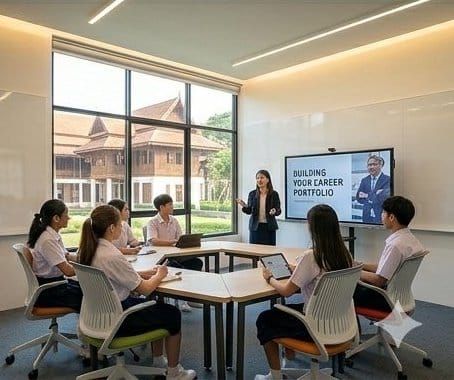
University Applications
A-Level study at Esara is designed with one eye firmly on your future. Whether you’re aiming for a UK university, the USA, Australia, or Southeast Asia, we’ll support you every step of the way.
Where do Esara students go?
Our graduates go on to study at universities across the UK, Europe, the USA, Australia, and Asia — in fields ranging from medicine and engineering to the arts, law, and business.
🇬🇧 UK Universities
🇺🇸 USA
🇦🇺 Australia
🇨🇳 Asia
🇪🇺 Europe
🇹🇭 Thailand
🇬🇧 UK University Applications (UCAS)
Applications to UK universities are made through UCAS in Year 13. Students choose up to five universities and write a personal statement. We support every step of this process.
🌍 International Applications
A-Level results are accepted widely by universities outside the UK. We help students research requirements, prepare applications, and understand how grades translate in different systems.
📝 Personal Statements
Your UCAS personal statement is one of the most important pieces of writing you’ll do. We begin working on this in Year 12, giving students time to craft something genuinely compelling.
🎓 Predicted Grades
Universities use predicted grades from Esara teachers to make conditional offers. We take predicted grades seriously — they are based on your actual performance, not optimism.
Start thinking early. University research begins in Year 12 at Esara. We hold university guidance sessions, help students explore options, and connect families with university representatives where possible.
Sixth Form Life at Esara

Sixth form at Esara isn’t just about exams. It’s about becoming the person you want to be. Students take on leadership roles, pursue their interests beyond the classroom, and begin to build the wider profile that universities look for.
👥 Student Leadership
Sixth form students take on leadership responsibilities — mentoring younger students, leading clubs and activities, and representing the school community.
📖 Extended Reading & Research
A-Level students are encouraged to read widely beyond the syllabus. Independent research and intellectual curiosity distinguish strong university applicants.
🏆 Enrichment & Extended Projects
Students may pursue an Extended Project Qualification (EPQ) — an independent research project that demonstrates university-level skills and enriches personal statements.
💚 Wellbeing
The pressure of sixth form is real. Our wellbeing team provides ongoing support — stress management, study skills, and personal guidance throughout Years 12 and 13.
Study Skills for A-Level Success


A-Level success is not just about intelligence — it’s about how you work. Students who do well typically share these habits.
Active revision from Day 1
Don’t wait until Year 13 to start revising. The most successful students build review and retrieval practice into their routine from the beginning of Year 12.
Read widely and independently
Examiners reward students who draw on knowledge beyond the textbook. Read newspapers, academic articles, and books related to your subjects.
Use past papers strategically
Past exam papers are your single most important revision tool. Practise under timed conditions and review mark schemes carefully.
Ask for help early — not at the last minute
If you’re struggling with a concept or coursework, speak to your teacher early. Every A-Level teacher at Esara is genuinely here to help.
Manage your time — and protect your rest
A-Level is a marathon, not a sprint. Build a sustainable weekly study schedule, protect your sleep, and maintain activities that give you energy.
A note on AI and academic integrity: Esara students are expected to produce their own work. Using AI to write coursework or essays is a serious breach of academic integrity. Using AI as a research aid or to check understanding is different — your teacher will guide you on appropriate use.
Support in Sixth Form
High expectations come with strong support. Here’s what every A-Level student at Esara can rely on.
🏫 Personal Tutor
Every sixth former has a personal tutor who meets with them regularly to track progress, discuss university plans, and provide personal support throughout Years 12 and 13.
📚 Subject Teachers
Our A-Level teachers are subject specialists. They hold regular office hours and are accessible for questions, coursework guidance, and targeted revision support.
🎓 University Guidance
Dedicated university guidance sessions run throughout Years 12 and 13, covering personal statements, university research, UCAS, and international applications.
💚 Wellbeing Team
Sixth form pressure is real. Our wellbeing team is always available — for exam anxiety, personal challenges, or simply when you need someone to talk to.

